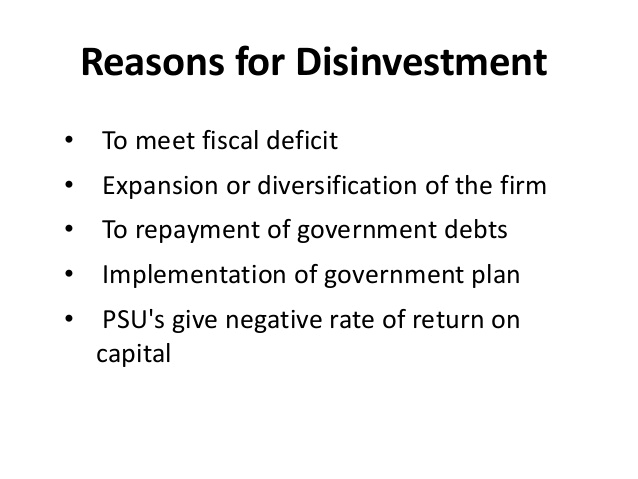
Disinvestment can be defined as the action of an organisation (or government) selling or liquidating an asset or subsidiary. Govt target for FY18 is 72500cr.
Various Ways of disinvestment-
• Sale of minority stake through IPO or Offer for Sale • Multiple disinvestments through Exchange Traded Funds in stock markets. Bharat 22 ETF Fund • Strategic Sale It started after 1991 economic policy and was suggested by Rangarajan committee in 1993 and Disinvestment Commission in 1996.
Disinvestment plan of Govt. of India-
• ministry name changed to DIPAM • Alternate Mechanism by CCEA where a minister’s panel will decide on strategic sale of PSU • Govt to come up with strategic disinvestment policy. This comes after more than a decade when privatisation of PSU was ended • Govt accepts NITI Aayog recommendation of strategic sale in 22 PSU up to 51% • National Investment Fund- It was created in 2005. All the proceeds from the disinvestment of Centre Public Sector Enterprises were to be channelized in this fund.
Advantages of disinvestment –
• Loss making PSU are a costly appendage • Trade unionism, inefficient workers and bureaucratic red tapism hamper growth • Private sector injects efficiency and technology • It ensures competition increases in market as private players increase • Fund raising for the government and release of stuck capital
Disadvantages of disinvestment-
• Loss of jobs and lesser government control • Private monopolies and cartels may be created • Undervaluation of assets while selling gets less money • Due to lack of private demand, govt asks LIC to buy shares • Corruption and delays in disinvestment process. FY17 target of 56000 cr never achieved.